Josefina Montoya
Santa Fe, NM – 1824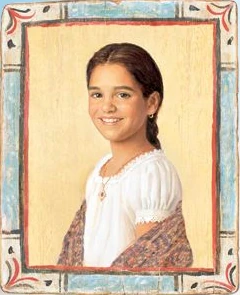
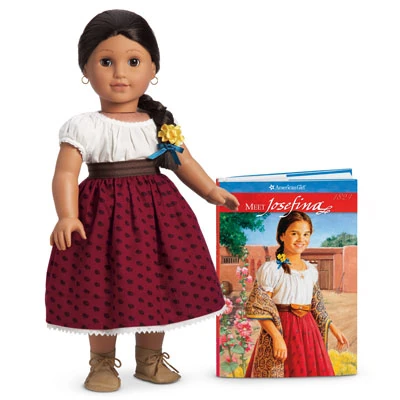
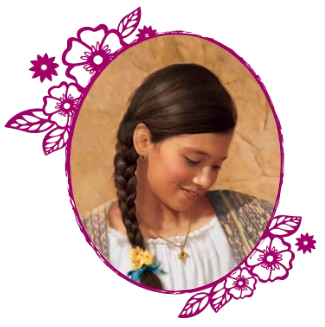
Josefina Montoya is a tender-hearted, quietly determined girl who feels things deeply and never stops looking for ways to grow. She lost her mother a year ago, and that grief shapes her, but rather than hardening her, it pushes her toward healing, both for herself and the people around her. Though she can be shy and hesitant at first, Josefina has a steady inner courage that tends to show up exactly when it’s needed. She’s the kind of person who listens before she speaks, thinks before she acts, and quietly earns the trust of everyone around her.
Many of Josefina’s books start with the following message:
Josefina and her family speak Spanish, so you’ll see some Spanish words in this book. You’ll find the meanings and pronounciations of these words in the [glossaries below].
Remember that in Spanish, “j” is pronounced like “h.” This means Josefina’s name is pronounced “ho-seh-FEE-nah.”
Books
Central Series
- Meet Josefina
- Josefina Learns a Lesson
- Josefina’s Surprise
- Happy Birthday, Josefina!
- Josefina Saves the Day
- Changes for Josefina
Short Stories
- Josefina’s Song
- Thanks to Josefina
- Just Josefina
- Again, Josefina!
- A Reward for Josefina
Mysteries
- Secrets in the Hills
- The Glowing Heart
More Information
When BeForever was introduced in 2014, they turned Josefina’s six Central Series books into two books: Sunlight and Shadows: A Josefina Classic Volume 1 and Second Chances: A Josefina Classic Volume 2. The first volume included the first three books of the Central Series, and the second volume included the last three books. In addition, they released a special choose-your-own-adventure book, Song of the Mockingbird: My Journey with Josefina.
When BeForever ended in 2019, they repackaged the stories again into two books: Sunlight and Shadows and Second Chances. The first book included just the first three of the Central Series, while the second book includes the last three. There are no major plot points removed, although some descriptions are shortened.
For more details about Josefina’s books, or see additional versions of books, please see the Official Fandom Page for Josefina’s books.
Glossary of Spanish words and places
| Word | Pronunciation | Description |
|---|---|---|
| Abuelita | ah-bweh-LEE-tah | Grandma |
| Abuelito | ah-bweh-LEE-toh | Grandpa |
| acequia | ah-SEH-kee-ah | a ditch made to carry water to a farmer’s fields |
| adiós | ah-dee-OHS | goodbye |
| adobe | ah-DOH-beh | a building material made of earth mixed with straw and water |
| banco | BAHN-ko | a bench built into the wall of a room |
| bienvenida | bee-en-veh-NEE-dah | welcome (used only to greet girls and women); the greeting for males and mixed groups is bienvenido |
| bizcochito | bees-ko-CHEE-toh | a kind of sugar cookie flavored with anise |
| buenos días | BWEH-nohs DEE-ahs | good morning |
| cautiva | kaw-TEE-vah | a female captive; a male captive is a cautivo |
| chile | CHEE-leh | a chili pepper |
| colcha | KOHL-chah | a kind of embroidery made with long, flat stitches |
| curandera | koo-rahn-DEH-rah | a woman who knows how to make medicines from plants and is skilled at healing |
| El Camino Real | el kah-MEE-no rey-AHL | the main road or trail that ran from Mexico City to New Mexico; its name means “Royal Road” |
| fandango | fahn-DAHNG-go | a big celebration or party that includes a lively dance |
| gracias | GRAH-see-ahs | thank you |
| La Jornada del Muerto | lah hor-NAH-dah del MWEHR-toh | the name of an especially rugged, waterless part of El Camino Real; the words literally mean “The Route of the Dead Man” |
| Los Charcos del Perillo | lohs CHAR-kohs del peh-REE-yo | the pools or springs of the little dog |
| Mamá | mah-MAH | Mother |
| mano | MAH-no | a stone held in the hand and used to grind corn; dried corn is put on a large flat stone called a metate, and then the mano is rubbed back and forth over the corn to break it down into flour |
| masa | MAH-sah | a dough made with cornmeal that is used in Mexican cooking |
| metate | meh-TAH-teh | a large flat stone used with a mano to grind corn |
| Papá | pah-PAH | Father |
| patrón | pah-TROHN | a man who has earned respect because he owns land and is a good leader of his family and his workers |
| piñón | pee-NYOHN | a kind of short, scrubby pine that produces delicious nuts |
| plaza | PLAH-sah | an open square in a village or town |
| pueblo | PWEH-blo | a village of Pueblo Indians |
| rancho | RAHN-cho | a ranch or farm where crops are grown and animals are raised |
| rebozo | reh-BO-so | a long shawl worn by girls and women |
| ristra | REE-strah | a string of fruit or vegetables that is hung up to dry, preserving the food for the winter |
| sala | SAH-lah | a room in a house |
| Santa Fe | SAHN-tah FEH | the capital city of New Mexico; its name means “Holy Faith” |
| Señor | seh-NYOR | Mr. |
| Señora | seh-NYO-rah | Mrs. |
| sí | SEE | yes |
| siesta | see-ES-tah | a rest or nap in the afternoon |
| sombrita | sohm-BREE-tah | little shadow, or an affectionate way to say “shadow;” the Spanish word for “shadow” is sombra |
| tamale | tah-MAH-leh | spicy meat surrounded by cornmeal dough and cooked in a corn-husk wrapping |
| tía | TEE-ah | aunt |
| tortilla | tor-TEE-yah | a kind of flat, round bread made of corn or wheat |
How to say Spanish names
| Name | Pronunciation |
|---|---|
| Ana | AH-nah |
| Andres | ahn-DREHS |
| Carmen | KAR-mehn |
| Clara | KLAH-rah |
| Dolores | doh-LO-rehs |
| Esteban | EHS-teh-bahn |
| Felipe | feh-LEE-peh |
| Francisca | frahn-SEES-kah |
| García | gar-SEE-ah |
| Jaramillo | hah-rah-MEE-yo |
| Josefina | ho-seh-FEE-nah |
| Luisa | loo-EE-sah |
| Magdalena | mahg-dah-LEH-nah |
| María | mah-REE-ah |
| Mariana | mah-ree-AH-nah |
| Mateo | mah-TEH-o |
| Miguel | mee-GEHL |
| Ofelia | o-FEE-lyah |
| Sanchez | SAHN-chehz |
| Teresita | teh-reh-SEE-tah |
| Tomás | toh-MAHS |